The Meaning of Om
SUMMARY
Om, also written as Aum, is one of the most sacred symbols in Hinduism. It represents the universe, consciousness, and the connection between the individual and the divine. The sound of Om is believed to embody creation, preservation, transformation, and spiritual awakening.
DOWNLOAD PDF
Om is considered the most sacred sound in Hinduism and is widely used in meditation, yoga, and spiritual practices throughout the world. Often written as “Aum,” it is much more than a spoken word or a symbolic image. It represents the essence of existence and the fundamental vibration from which the universe emerged.
Ancient Hindu scriptures describe Om as the original sound of creation. According to these texts, everything in the universe originated from a single cosmic vibration, and that vibration is symbolized by Om. For thousands of years, sages and spiritual practitioners have used this sacred sound as a tool for meditation and self-realization.
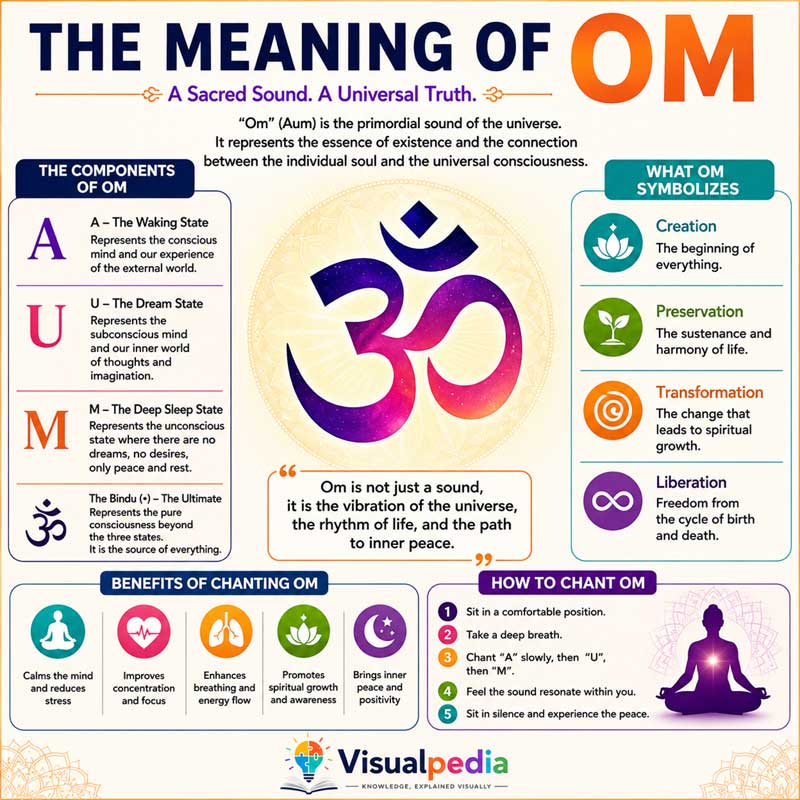
The word Om is traditionally divided into three sounds: A, U, and M.
The sound “A” represents the waking state. This is the state in which people experience the physical world through their senses. It symbolizes awareness, activity, and conscious thought.
The sound “U” represents the dream state. This stage reflects the subconscious mind, imagination, emotions, and inner experiences. It represents the transition between the external and internal worlds.
The sound “M” represents deep sleep. In this state, there are no dreams or conscious thoughts. It symbolizes peace, rest, and a deeper level of awareness.
After the pronunciation of A-U-M comes silence. In Hindu philosophy, this silence represents a higher state of consciousness that goes beyond waking, dreaming, and deep sleep. It symbolizes enlightenment, spiritual freedom, and complete unity with the universe.
The Om symbol itself contains several meaningful elements. The larger curve at the bottom represents the waking state, while the middle curve represents the dream state. The upper curve symbolizes deep sleep. The dot above the symbol represents the highest state of consciousness, and the curved line separating the dot from the other parts symbolizes illusion, which prevents people from recognizing their true spiritual nature.
Om also represents the cycle of creation, preservation, and transformation. These three universal forces are often associated with the Hindu deities Brahma, Vishnu, and Shiva. Together, they symbolize the continuous process through which the universe evolves.
Today, Om is commonly used in yoga sessions around the world. Many instructors begin and end their classes with the chanting of Om because it helps create a peaceful environment and encourages mental focus.
Scientific studies have suggested that repetitive chanting and controlled breathing can help reduce stress, improve concentration, and promote relaxation. Although the spiritual meaning of Om extends far beyond these physical benefits, many practitioners find that chanting helps calm the mind and improve emotional well-being.
Chanting Om is relatively simple. Sit comfortably, take a deep breath, and slowly pronounce the sounds “A,” “U,” and “M.” Allow the vibration to resonate throughout your body, and then remain silent for a few moments. This practice encourages mindfulness and creates a deeper connection between the mind and the present moment.
Regardless of religious beliefs, many people appreciate Om as a universal symbol of peace, harmony, and self-awareness. It reminds us that everything in the universe is interconnected and that inner peace begins with understanding ourselves.
Key Takeaways
- Om is one of the most sacred symbols in Hinduism.
- Om is pronounced as A-U-M.
- The three sounds represent waking, dreaming, and deep sleep.
- The silence after chanting symbolizes transcendental consciousness.
- Om represents the universe and the connection between the individual and the divine.
- Chanting Om may help improve concentration and reduce stress.
- The symbol is widely used in meditation and yoga practices.
- Om represents peace, unity, and spiritual awakening.
FAQs
1. What does Om mean?
Om represents the universe, consciousness, and the divine source of all existence.
2. Is Om only associated with Hinduism?
Although Om originated in Hinduism, it is also respected in Buddhism, Jainism, yoga, and many spiritual traditions.
3. Why do people chant Om during meditation?
People chant Om to improve focus, calm the mind, and create a sense of inner peace.
4. What do the letters A-U-M represent?
They represent the waking state, the dream state, and the deep sleep state of human consciousness.
5. Can anyone chant Om?
Yes. People from different cultures and backgrounds practice Om chanting for meditation, relaxation, and spiritual growth.