Difference between 4G and 5G?
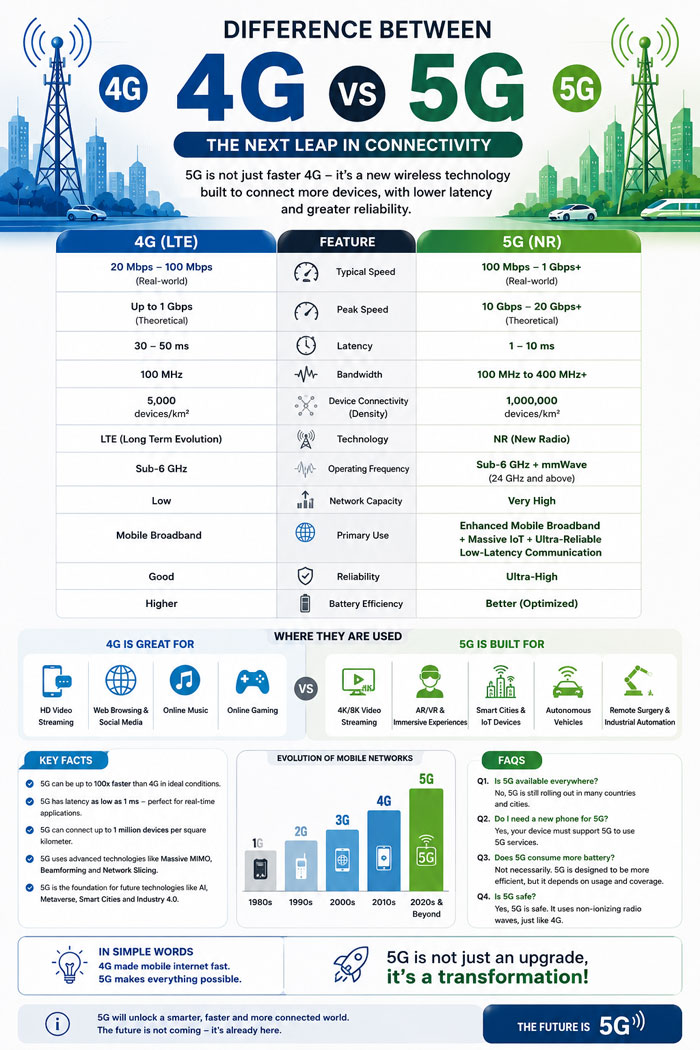
Difference Between 4G and 5G
4G and 5G are two generations of mobile network technology, but they differ significantly in speed, latency, capacity, and the types of applications they support. While 4G revolutionized mobile internet by enabling HD streaming and fast browsing, 5G is designed to power the next generation of connected technologies, including smart cities, autonomous vehicles, virtual reality, and the Internet of Things (IoT).
What is 4G?
The fourth-generation (4G LTE) network became the global standard for mobile connectivity by offering high-speed internet, smooth video streaming, and improved voice quality over previous generations. It enabled millions of people to work remotely, access cloud services, and enjoy seamless entertainment on smartphones.
What is 5G?
The fifth-generation (5G NR) network goes much further. It is not simply a faster version of 4G—it is an entirely new wireless communication system designed to handle far more connected devices while significantly reducing network latency. This means users experience near-instant response times, making applications like cloud gaming, remote surgery, augmented reality (AR), virtual reality (VR), industrial automation, and autonomous driving possible.
Key Differences at a Glance
One of the biggest differences is speed. Typical real-world 4G download speeds range from 20–100 Mbps, while 5G commonly delivers 100 Mbps to over 1 Gbps, with theoretical speeds reaching 10–20 Gbps under ideal conditions. Another major improvement is latency—4G networks generally have latency between 30–50 milliseconds, whereas 5G can reduce this to 1–10 milliseconds, enabling real-time communication for critical applications.
5G also dramatically increases network capacity. While a 4G network can support approximately 5,000 connected devices per square kilometer, a 5G network can support up to 1 million devices in the same area, making it ideal for smart cities, connected factories, and massive IoT deployments.
Although 5G offers substantial improvements, 4G will continue to play an important role for years. Many regions still rely on 4G infrastructure, and smartphones automatically switch between 4G and 5G depending on network availability.
Quick Comparison
| Feature | 4G | 5G |
|---|---|---|
| Typical Speed | 20–100 Mbps | 100 Mbps–1 Gbps+ |
| Peak Speed | Up to 1 Gbps | Up to 20 Gbps |
| Latency | 30–50 ms | 1–10 ms |
| Technology | LTE | NR (New Radio) |
| Capacity | ~5,000 devices/km² | Up to 1,000,000 devices/km² |
| Reliability | High | Ultra High |
| Best For | Streaming, Browsing | AR, VR, AI, IoT, Smart Cities |
Key Takeaways
- 5G is significantly faster than 4G.
- 5G offers much lower latency.
- 5G supports far more connected devices.
- 4G is ideal for everyday internet usage.
- 5G enables emerging tech like autonomous vehicles.
- 4G networks will continue alongside 5G.
- Most modern smartphones support both.
- 5G improves network efficiency and user experience.
Key Facts
Frequently Asked Questions (FAQs)
Is 5G faster than 4G?
Yes. 5G delivers significantly higher download and upload speeds than 4G.
Do I need a new phone for 5G?
Yes. You need a smartphone that supports 5G connectivity.
Does 5G replace 4G?
No. Both networks currently operate together, and devices switch between them depending on coverage.
Is 5G safe?
Yes. 5G uses non-ionizing radio frequencies and operates within internationally regulated safety standards.
Why is 5G important?
It enables next-generation applications such as smart cities, remote healthcare, autonomous vehicles, cloud gaming, and industrial automation.
Will 4G become obsolete?
Not anytime soon. 4G will remain widely available for several years as 5G infrastructure continues to expand.
Does 5G consume more battery?
Early 5G devices consumed more power, but modern smartphones are optimized for improved battery efficiency.
Is 5G available everywhere?
Coverage is expanding rapidly, but availability varies by country and region.




0 Comments