How Does DRS Work in Cricket?
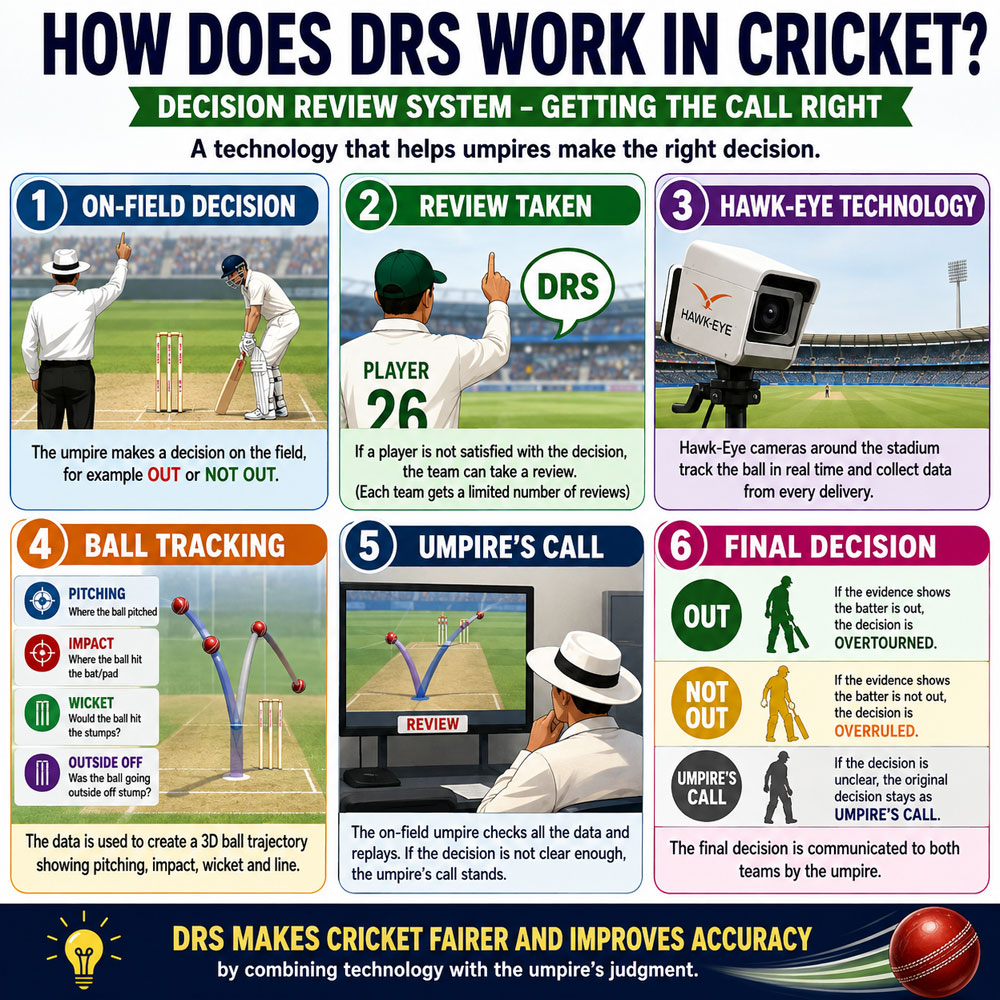
DRS (Decision Review System) is a technology-assisted system used in cricket to help umpires review certain on-field decisions. When a team challenges a decision, technologies such as Hawk-Eye ball tracking, video replays, and other available tools are used to examine what happened. The evidence is reviewed by the TV/third umpire, while the on-field umpire makes the final decision according to the applicable playing conditions.
How Does DRS Work in Cricket?
The Decision Review System (DRS) is one of the most important technologies introduced to modern cricket. It allows teams to challenge certain on-field decisions when they believe an umpire may have made an error. The system combines video replays, ball-tracking technology, and other technological tools to help officials reach a more accurate decision.
1. The Umpire Makes the Original Decision
Everything starts with the on-field umpire. For example, the umpire may give a batter OUT for LBW or declare a player NOT OUT.
If the fielding or batting team believes the decision is incorrect, they may request a review, subject to the competition’s DRS rules.
2. The Team Requests a Review
The captain or designated player signals for a DRS review. Teams have a limited number of unsuccessful reviews, with the exact allowance depending on the format and competition rules.
The review is then referred to the third umpire for examination.
3. Video and Technology Are Used
The third umpire examines available evidence, which can include multiple camera angles, slow-motion replays, and technologies such as Hawk-Eye ball tracking.
For LBW decisions, ball tracking can estimate the ball’s path before and after impact.
4. Ball Tracking Examines the Delivery
Ball-tracking technology can reconstruct the ball’s trajectory and provide information such as:
- Where the ball pitched
- Where it struck the batter
- Whether it was likely to hit the stumps
This is particularly important for LBW reviews.
5. Umpire’s Call
One of the most misunderstood parts of DRS is Umpire’s Call.
In certain marginal situations, the technology may show that the outcome falls within the tolerance used by the DRS system. In those circumstances, the original on-field decision can remain unchanged.
This means DRS is not simply a system that automatically replaces the umpire’s decision.
6. The Final Decision
After examining the available evidence, the third umpire communicates the result to the on-field umpire. The on-field umpire then announces the final outcome.
Depending on the evidence and the applicable rules, the original decision may be upheld or overturned.
Why Is DRS Important?
Cricket involves extremely fast events that can be difficult for the human eye to judge perfectly. DRS provides officials with additional evidence and can help correct clear mistakes.
However, technology does not eliminate the role of the umpire. Instead, DRS combines technology with human judgment to make important decisions more accurate and consistent.
That’s why DRS has become such an important part of modern cricket.
Key Takeaways
- 🏏 DRS stands for Decision Review System.
- 📡 It allows teams to challenge certain on-field decisions under the applicable playing conditions.
- 📺 The third umpire reviews the available evidence.
- 🎯 Hawk-Eye ball tracking can reconstruct the trajectory of a cricket ball.
- 📊 DRS can examine factors such as pitching, impact, and whether the ball would hit the stumps for relevant LBW reviews.
- 🎥 Video replays and other technologies can also be used depending on the decision.
- ⚖️ Umpire’s Call can allow the original decision to remain in certain marginal situations.
- 👨⚖️ DRS does not completely replace the on-field umpire.
- ✅ The purpose of DRS is to reduce clear errors and improve decision-making.
- 📋 The exact review procedures and allowances can vary according to the format and competition playing conditions.
What does DRS stand for in cricket?
DRS stands for Decision Review System. It allows teams to challenge certain on-field decisions and have them reviewed using available technology.
Who makes the final decision during a DRS review?
The third umpire reviews the evidence and communicates the result to the on-field umpire, who then gives the final decision according to the applicable playing conditions.
What is Hawk-Eye used for in cricket?
Hawk-Eye is used for technologies such as ball tracking, which can reconstruct the ball’s trajectory. It is particularly important when reviewing LBW decisions.
What does ball tracking show?
Ball tracking can show where the ball pitched, where it made contact with the batter, and its projected path toward the stumps.
What is Umpire’s Call?
Umpire’s Call refers to certain marginal DRS outcomes where the technology falls within the defined tolerance around a key part of the decision. In such circumstances, the original on-field decision can remain unchanged.
Can DRS overturn an umpire’s decision?
Yes. If the review provides sufficient evidence that the original decision was incorrect, the decision can be overturned. However, the outcome depends on the applicable DRS rules and the evidence available.
Can every cricket decision be reviewed?
No. DRS is governed by specific rules, and not every decision or situation is eligible for review.
How many reviews does each team get?
The number of available reviews depends on the format and competition rules. Teams also have limits on unsuccessful reviews.
Why was DRS introduced?
DRS was introduced to provide officials with additional evidence and help reduce significant human errors in important cricket decisions.
Does DRS replace cricket umpires?
No. DRS is designed to assist umpires, not eliminate them. Human judgment remains an important part of the decision-making process.




0 Comments