Do Morning Dreams Come True? Myth vs Truth
Summary
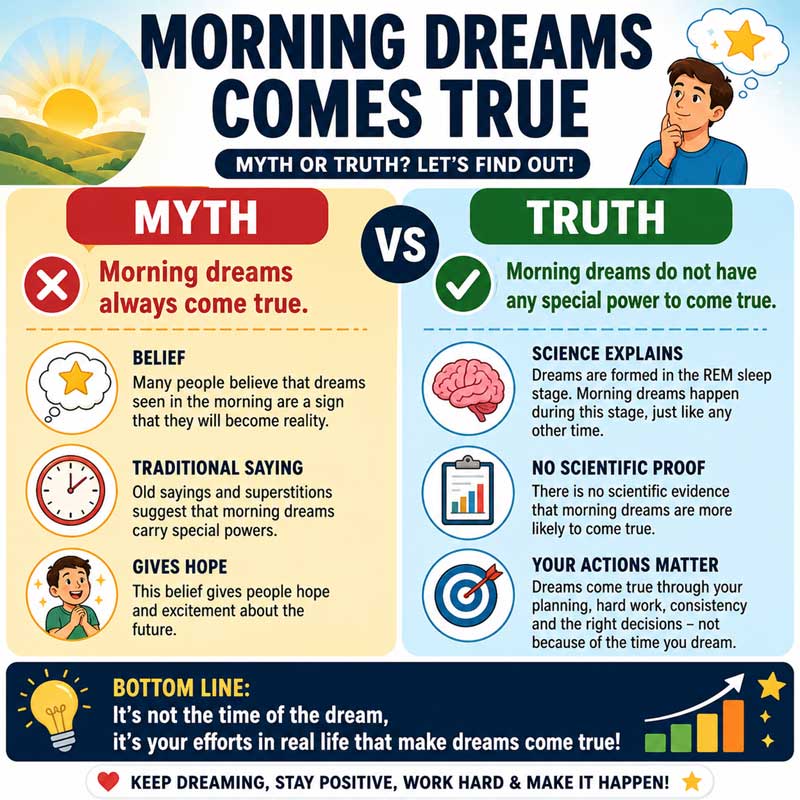
Many people believe that dreams seen in the early hours of the morning eventually become reality. However, scientific research suggests that dreams are products of brain activity during sleep. There is no evidence proving that morning dreams have a greater chance of coming true.
DOWNLOAD PDF
Does Morning Dreams Come True? (Myth or Truth)
Dreams have fascinated people for thousands of years. Across different cultures, there is a common belief that morning dreams come true more often than dreams seen at other times during the night.
Many people wake up after an emotional dream and immediately ask, “Does morning dreams come true?” Others wonder whether dreams experienced at sunrise carry a hidden message about the future.
The short answer is no scientific evidence supports the claim that dreams seen in the morning are more likely to become reality.
So, why do so many people believe otherwise?
The answer lies in the way our brains function during sleep.
Human sleep is divided into several stages. One of these stages is called Rapid Eye Movement (REM) sleep, which is the period during which most vivid dreams occur. REM cycles become longer as the night progresses. This means that dreams experienced shortly before waking are usually longer, more detailed, and easier to remember.
This explains why many people believe that early morning dreams come true. Since these dreams are more vivid, they leave a stronger emotional impression.
Another psychological factor is selective memory.
Suppose you dream about meeting an old friend. A few days later, that friend unexpectedly calls you. Your brain immediately connects the event to the dream and concludes that the dream predicted the future.
However, people rarely remember the hundreds of dreams that never matched real-life events.
This tendency is known as confirmation bias. We naturally focus on experiences that support our beliefs while ignoring those that contradict them.
Many people also ask, “At what time morning dreams come true?” There is no scientific timetable that determines whether a dream seen at 5 a.m. or 7 a.m. has a higher probability of becoming reality.
In fact, questions such as “Do 5 a.m. dreams come true?” and “Does morning 7 a.m. dreams come true?” cannot be answered with scientific evidence because no research has demonstrated a connection between dream timing and future events.
Religious and spiritual traditions often offer different interpretations.
Some people ask whether morning dreams come true in Hinduism. Hindu scriptures discuss dreams in various contexts, but interpretations differ among traditions and scholars. Dreams are often viewed as symbolic rather than literal predictions.
Similarly, many people wonder whether morning dreams come true in Islam. Islamic teachings generally classify dreams into different categories, including meaningful dreams and ordinary dreams influenced by daily experiences. However, interpretations vary, and dreams are not universally considered predictions of future events.
Questions such as “Do morning dreams come true spiritually?” often arise because spiritual traditions frequently assign symbolic meaning to dreams. Rather than predicting specific events, many spiritual interpretations suggest that dreams may reflect inner emotions, fears, hopes, or unresolved thoughts.
Another common concern involves unpleasant dreams.
People often ask whether morning bad dreams come true or whether a disturbing dream should be taken seriously.
Psychologists suggest that frightening dreams are usually connected to stress, anxiety, traumatic experiences, or emotional concerns. A bad dream is not necessarily a warning about future events.
Many individuals also search for answers to why do I dream early in the morning.
The explanation is relatively simple. As you approach your normal waking time, your brain spends more time in REM sleep. Longer REM periods produce more vivid dreams, making them easier to recall after waking.
So, do dreams in the early morning come true?
Science says there is no evidence proving that they do.
Can dreams occasionally resemble future events?
Yes.
But coincidence, selective memory, emotional attachment, and the brain’s tendency to recognize patterns often explain these experiences.
The real lesson is simple.
Dreams can inspire us, reveal our emotions, and stimulate our imagination. But our future depends far more on our decisions, actions, discipline, and effort than on the time at which we happen to dream.
The verdict?
Morning dreams coming true is largely a myth rather than a scientifically proven fact.
Key Takeaways
- There is no scientific evidence proving that morning dreams predict the future.
- Dreams are most vivid during REM sleep, which is more common in the early morning.
- Confirmation bias often makes people remember dreams that seem to match real events.
- Different religions and cultures interpret dreams differently.
- Good or bad dreams should not be treated as guaranteed predictions.
- Personal effort and decision-making influence the future far more than dreams.