Top 10 Technologies That Will Change the World in the Future (2026 Guide)
Summary
The world’s biggest technological revolution is already underway. Artificial intelligence, robotics, biotechnology, renewable energy, and other emerging technologies are transforming industries, solving global challenges, and creating a future that once seemed possible only in science fiction.
DOWNLOAD PDF
Technology has always shaped human civilization, from the invention of the wheel to the development of the internet. Today, we’re entering another major technological revolution that will redefine industries, economies, healthcare, education, transportation, and communication.
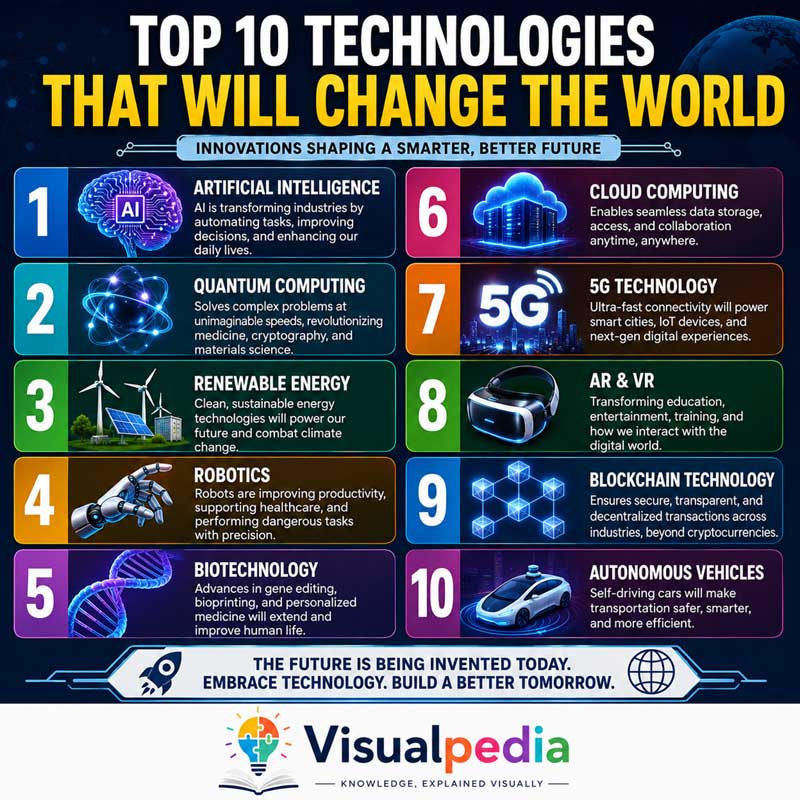
Let’s explore the top 10 technologies that will change the world.
1. Artificial Intelligence (AI)
Artificial intelligence has become one of the most influential technologies of the 21st century. AI systems can analyze massive amounts of data, recognize patterns, automate tasks, and even make decisions.
AI is already transforming healthcare by assisting doctors in diagnosing diseases. Businesses use AI-powered chatbots for customer service, while streaming platforms rely on AI to recommend personalized content.
In the future, AI will continue to improve productivity, automate repetitive tasks, and create smarter systems across every industry.
2. Quantum Computing
Traditional computers process information using bits that exist as either 0 or 1. Quantum computers use quantum bits, or qubits, which can exist in multiple states simultaneously.
This technology could solve complex problems in minutes that would take conventional computers thousands of years.
Quantum computing could revolutionize medicine, cybersecurity, financial modeling, weather forecasting, and scientific research.
3. Renewable Energy Technologies
Climate change has increased the demand for cleaner energy sources. Renewable energy technologies, including solar, wind, hydroelectric, and geothermal systems, are becoming more efficient and affordable.
Future advancements in energy storage and battery technology will help reduce dependence on fossil fuels and create more sustainable energy systems worldwide.
4. Robotics
Robotics has moved far beyond factory automation. Modern robots assist surgeons in operating rooms, help farmers improve crop production, and perform dangerous tasks in hazardous environments.
Humanoid robots capable of interacting naturally with people are becoming increasingly advanced.
As robotics technology evolves, robots will become valuable partners in healthcare, manufacturing, logistics, and education.
5. Biotechnology
Biotechnology combines biology with technology to improve human health and agricultural production.
Scientists are developing new methods of gene editing, personalized medicine, artificial organs, and bioprinting.
Advanced biotechnology could lead to more effective treatments for genetic disorders, cancer, and infectious diseases while improving food production and environmental sustainability.
6. Cloud Computing
Cloud computing allows individuals and organizations to store, process, and access data through remote servers rather than local computers.
Businesses increasingly depend on cloud services for collaboration, data management, and application development.
The future of cloud computing includes faster processing, improved security, and better integration with AI-powered systems.
7. 5G Technology
The rollout of 5G networks is dramatically increasing internet speeds and reducing communication delays.
Faster connectivity will support smart cities, autonomous vehicles, industrial automation, and the Internet of Things (IoT).
As network infrastructure improves, billions of connected devices will communicate more efficiently than ever before.
8. Augmented Reality (AR) and Virtual Reality (VR)
AR overlays digital information onto the real world, while VR creates completely immersive digital environments.
These technologies are already transforming gaming and entertainment. However, their impact will extend far beyond those industries.
Education, healthcare, employee training, architecture, and remote collaboration will all benefit from more immersive digital experiences.
9. Blockchain Technology
Blockchain provides a secure and decentralized method of recording transactions.
Although it’s commonly associated with cryptocurrencies, blockchain technology has applications in healthcare, banking, supply chain management, and digital identity verification.
Its ability to provide transparency and improve security makes it one of the most promising technological innovations.
10. Autonomous Vehicles
Self-driving vehicles use artificial intelligence, sensors, cameras, and machine learning algorithms to navigate roads without human intervention.
Autonomous vehicles have the potential to reduce traffic accidents, improve fuel efficiency, and make transportation more accessible.
Although fully autonomous transportation is still developing, significant progress continues to be made.
The Future Is Closer Than We Think
Many of these technologies are already influencing our daily lives. Their impact will only increase over the next decade.
The challenge for society will be learning how to use these innovations responsibly while ensuring they benefit everyone.
The future won’t be defined by a single technology. Instead, it will be shaped by the combination of multiple innovations working together to solve some of humanity’s greatest challenges.
Key Takeaways
-
✔ Artificial intelligence will continue transforming every major industry.
✔ Quantum computing could solve problems that traditional computers cannot.
✔ Renewable energy technologies will play a crucial role in combating climate change.
✔ Robotics will improve healthcare, manufacturing, and agriculture.
✔ Biotechnology could revolutionize medicine through gene editing and personalized treatments.
✔ 5G networks will accelerate communication and support smart cities.
✔ AR and VR technologies will reshape education, entertainment, and remote work.
✔ Blockchain will improve transparency and digital security.
✔ Autonomous vehicles could make transportation safer and more efficient.
✔ The future will be shaped by the combination of multiple emerging technologies.