Why Does Cricket ball Swings
Summary
A cricket ball swings because its seam, surface condition and orientation affect the airflow around it. Unequal airflow and pressure on the two sides create an aerodynamic force that pushes the ball sideways. Speed, seam position, ball condition and atmospheric conditions can all influence the amount of swing.
DOWNLOAD PDF
Why Does a Cricket Ball Swing?
Swing bowling is one of the most fascinating examples of physics in cricket. A fast bowler can deliver the ball straight toward the batter, yet the ball suddenly moves sideways through the air. This movement is called swing.
But what causes it?
The answer lies mainly in airflow, the seam, surface condition and pressure differences around the cricket ball.
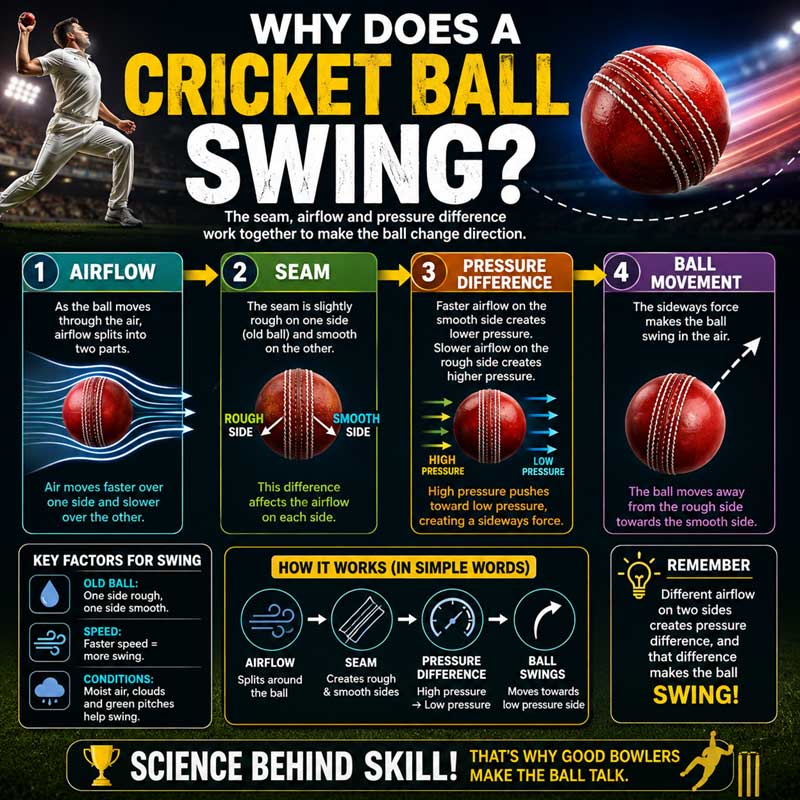
1. Airflow Around the Ball
When a cricket ball travels through the air, air flows around its surface. Ideally, if the ball were perfectly smooth and symmetrical, the airflow would behave similarly on both sides.
But a cricket ball isn’t perfectly symmetrical.
It has a prominent seam, and as the ball gets older, one side can become rougher while the other is kept relatively smooth. These differences affect how the air moves around the ball.
2. The Seam Plays a Major Role
Fast bowlers carefully position the seam when attempting to swing the ball.
A slightly angled seam can disturb the airflow on one side and encourage the airflow to behave differently on the other side.
This difference is important because the airflow does not separate from the ball in exactly the same way on both sides.
The result is an imbalance in aerodynamic forces acting on the ball.
3. Pressure Difference Creates Movement
The different airflow patterns around the two sides of the ball can produce a pressure difference.
In simplified terms, one side experiences relatively higher pressure while the other experiences relatively lower pressure.
This pressure imbalance produces a sideways aerodynamic force.
That force causes the ball to move laterally rather than continuing along a perfectly straight path.
So the basic chain is:
Airflow → Seam & Surface → Pressure Difference → Aerodynamic Force → Ball Swings
4. Why Does an Old Ball Behave Differently?
As a cricket ball gets older, its surface changes.
One side is often deliberately polished by players, while the other becomes rougher through contact with the pitch and general wear.
This creates an important difference between the two sides.
Fast bowlers try to maintain the shine on one side and use the seam and release angle to influence the airflow.
This is why the condition of the ball becomes increasingly important as an innings progresses.
5. Conventional Swing
Conventional swing generally occurs when the ball is relatively new and the bowler uses the seam and surface differences to influence airflow.
The bowler’s wrist position, seam orientation and release are crucial.
A good bowler can make relatively small changes in seam angle and wrist position that significantly affect the ball’s trajectory.
6. Reverse Swing
Reverse swing is a different phenomenon that can occur when the ball becomes considerably older.
At high speeds, the rough and smooth surfaces can interact with the airflow differently from a newer ball. The direction and behavior of the aerodynamic force can change.
This is one reason why experienced fast bowlers can be extremely dangerous with an older ball.
7. Does Weather Matter?
Yes.
Atmospheric conditions can influence swing bowling. Humidity, air density, wind and other environmental factors can affect the aerodynamic behavior of the ball.
However, it’s an oversimplification to say that “humidity automatically makes the ball swing.”
The actual amount of movement depends on several factors working together—including the ball’s condition, seam position, speed, release and surrounding airflow.
8. The Bowler’s Skill
Ultimately, swing isn’t simply something that happens automatically because a ball has a seam.
The bowler has to control several variables:
- Seam orientation
- Wrist position
- Release angle
- Ball speed
- Line and length
- Ball condition
A tiny change in release can alter the ball’s trajectory.
That’s why swing bowling is such a powerful combination of skill and science.
The next time you watch a fast bowler deliver a ball that appears to move mysteriously through the air, remember the chain:
AIRFLOW → SEAM → PRESSURE DIFFERENCE → BALL MOVEMENT
What looks like magic on the cricket field is actually a beautiful demonstration of aerodynamics and physics.
Key Takeaways
- 🏏 Swing is sideways movement of the cricket ball through the air.
- 🌬️ Airflow around the ball is central to swing.
- 🧵 The seam orientation influences how air flows around the ball.
- ⚖️ Different airflow patterns can create a pressure difference between the two sides.
- ➡️ The resulting aerodynamic force causes the ball to move sideways.
- ✨ A polished side and rough side can produce different airflow behavior.
- 🚀 Speed, seam position, wrist position and release all matter.
- 🌦️ Atmospheric conditions can also influence swing.
- 🔄 Reverse swing involves different aerodynamic behavior, particularly with an older ball.
- 🧠 Great swing bowling combines physics with precise bowling skill.