How IPL Salary System Works: Complete Guide to IPL Player Salaries, Auctions and Contracts
Summary
The IPL salary system is based on a fixed team budget, player auctions, retention policies, and contractual agreements. Franchises compete to sign players while staying within a salary cap, creating one of the most exciting and financially structured sporting leagues in the world.
DOWNLOAD PDF
How IPL Salary System Works
The Indian Premier League (IPL) is not only one of the world’s most popular cricket tournaments but also one of the richest sporting leagues. Every season, fans are amazed by players being purchased for several crores during the IPL auction. But have you ever wondered how this salary system actually works?
Let’s understand the IPL salary structure step by step.
1. Every Team Gets a Fixed Salary Purse
Before the auction begins, the Board of Control for Cricket in India (BCCI) allocates a fixed amount of money, known as the salary purse, to every franchise.
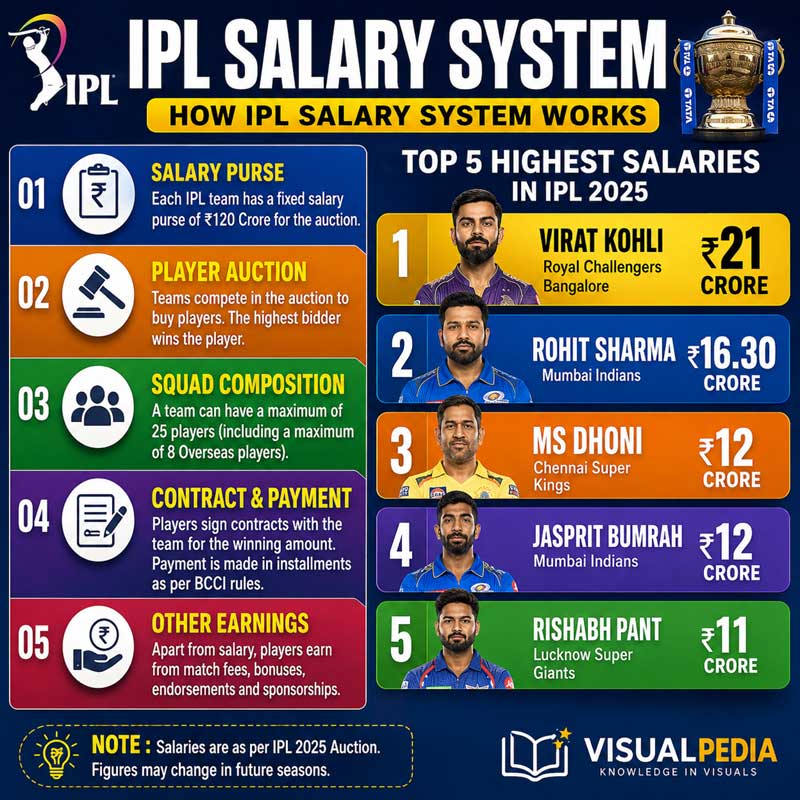
For the 2025 season, each team was allowed a purse of approximately ₹120 crore.
This rule ensures that all teams compete on relatively equal financial terms. Wealthier franchises cannot simply spend unlimited amounts to buy every star player.
The purse must cover:
- Retained players
- Auction purchases
- Replacement players
2. Player Retention Happens Before the Auction
Before the auction begins, franchises can retain some players from their previous squads.
Retention allows teams to keep their most valuable players without competing against other franchises in the auction.
However, the salaries of retained players are deducted from the team’s total salary purse.
For example, if a franchise retains players worth ₹60 crore, only ₹60 crore remains for auction purchases.
3. The IPL Auction Determines Player Salaries
The IPL auction is the most exciting part of the salary system.
Every player enters the auction with a base price.
Common base prices include:
- ₹30 lakh
- ₹50 lakh
- ₹75 lakh
- ₹1 crore
- ₹2 crore
Franchises then bid against one another.
The player joins the team that offers the highest bid.
For example:
- Base price: ₹2 crore
- Final bid: ₹18 crore
The player’s salary for that season becomes ₹18 crore.
Some players receive salaries many times higher than their original base price because multiple franchises compete to sign them.
4. Teams Must Follow Squad Composition Rules
An IPL team cannot buy an unlimited number of players.
According to league regulations, every squad can include a maximum of 25 players.
Additionally:
- Only 8 overseas players can be included in the squad.
- Only 4 overseas players can be part of the playing eleven during a match.
These rules help maintain balance across all teams.
5. Players Sign Official Contracts
Once the auction ends, players sign contracts with their respective franchises.
The contract includes:
- Salary amount
- Duration of the agreement
- Player obligations
- Availability requirements
- Payment terms
The contract legally binds both the player and the franchise.
6. How Are IPL Players Paid?
IPL players do not usually receive their entire salary in a single payment.
Instead, payments are generally divided into installments according to contractual terms and BCCI guidelines.
If a player becomes unavailable because of injury or other circumstances, payment conditions may vary depending on the contract.
7. IPL Salary Isn’t the Only Source of Income
Many players earn far more than their IPL salaries.
Additional sources of income include:
- Match fees from international cricket
- Brand endorsements
- Sponsorship agreements
- Social media promotions
- Commercial appearances
For many star cricketers, endorsements can sometimes exceed their IPL earnings.
Top 5 Highest Salaries in IPL 2025
| Rank | Player | Salary |
|---|---|---|
| 1 | Virat Kohli | ₹21 crore |
| 2 | Rohit Sharma | ₹16.30 crore |
| 3 | MS Dhoni | ₹12 crore |
| 4 | Jasprit Bumrah | ₹12 crore |
| 5 | Rishabh Pant | ₹11 crore |
These figures demonstrate the enormous commercial value of elite cricketers in the IPL ecosystem.
Why Does the IPL Use a Salary Cap?
The salary cap serves several important purposes:
- IPL teams operate under a fixed salary purse.
- Player retention reduces the available auction budget.
- Player salaries are primarily determined through competitive bidding.
- Every squad can include a maximum of 25 players.
- IPL contracts define salary and payment conditions.
- Players also earn money through endorsements and sponsorships.
- Salary caps help maintain competitive balance among franchises.
Without a salary cap, financially stronger franchises could dominate the tournament.
The IPL salary system combines sports, economics, and entertainment into a model that many other leagues around the world have tried to emulate.
Key Takeaways
- Feeling sleepy after eating is a normal biological response.
- Digestion requires a significant amount of energy.
- Carbohydrates increase serotonin production.
- Tryptophan contributes to the production of sleep-related hormones.
- Heavy meals are more likely to cause drowsiness.
- Your body’s internal clock naturally reduces alertness during the afternoon.
- Smaller, balanced meals can help reduce post-meal fatigue.