An Owl’s Hoot Predicts Death or Bad Luck
Summary
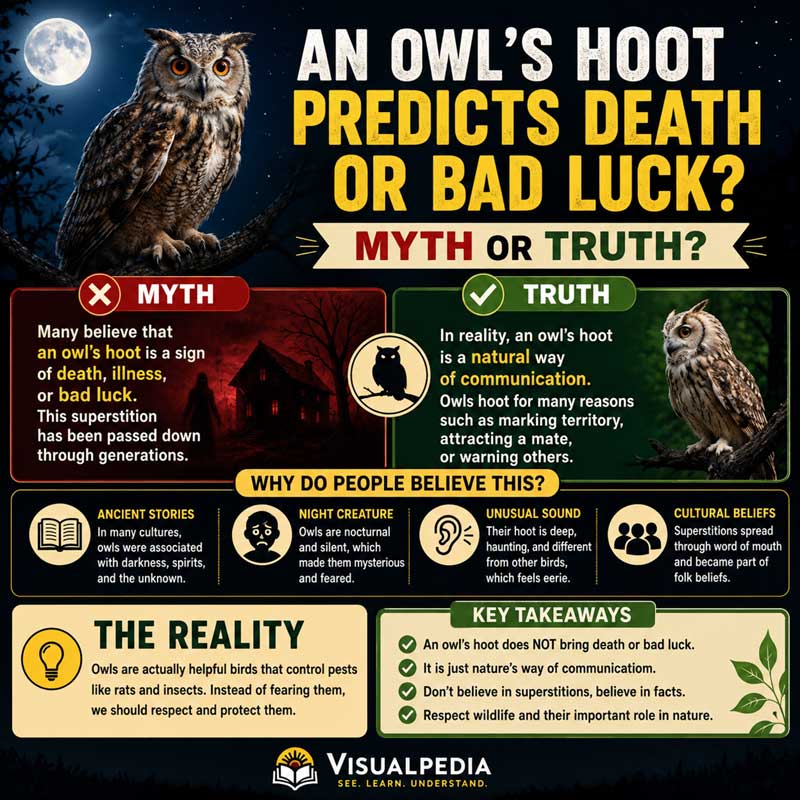
The belief that an owl’s hoot predicts death or bad luck is a superstition, not a scientific fact. Owls hoot primarily to communicate, defend territories, attract mates and interact with other owls. Their nocturnal habits and mysterious calls likely contributed to their association with bad omens.
For generations, the sound of an owl hooting at night has been surrounded by mystery and superstition. In some cultures, hearing an owl near a home has been interpreted as a warning of death, illness or impending misfortune. But does an owl’s hoot really predict something bad?
The answer is no. There is no scientific evidence that an owl’s hoot can predict death, illness or bad luck. The belief is a cultural superstition that likely developed because of the owl’s unusual appearance, nocturnal lifestyle and haunting calls.
Why Are Owls Associated With Death and Bad Luck?
Owls are primarily nocturnal, meaning they are most active during the night. Historically, nighttime was associated with darkness, danger and the unknown. Before modern science and artificial lighting, hearing an unfamiliar animal calling in the darkness could naturally seem frightening.
The owl’s appearance may have added to this mystery. Its large eyes, silent flight and ability to see in low light made it seem very different from ordinary daytime birds.
Its hoot can also sound eerie or unusually deep. When people heard an owl calling outside their homes at night, they sometimes connected the unusual sound with unfortunate events that happened afterward.
This is an example of how superstitions can develop when people connect two unrelated events.
Why Do Owls Actually Hoot?
An owl’s hoot is a natural form of communication. Different owl species produce different sounds, and vocalizations can serve several purposes.
One important reason is territorial behavior. A male or female owl may use calls to communicate that a particular area is occupied and warn other owls to stay away.
Owls may also call to attract or communicate with a mate. During breeding periods, vocal activity can become more noticeable.
Some owls also use sounds to communicate with their partners or young and to respond to nearby owls.
Therefore, when you hear an owl hooting at night, it is far more likely that you are simply hearing an animal communicating than receiving a supernatural warning.
Why Does the Belief Continue?
Superstitions often survive because they are passed from one generation to another. Stories about owls and bad omens have appeared in different cultures throughout history.
There is also a psychological reason behind such beliefs. If someone hears an owl and later experiences something unfortunate, they may remember the two events as connected. But if nothing happens after hundreds of other owl calls, those ordinary experiences are usually forgotten.
This tendency to notice and remember events that appear to confirm an existing belief can make superstitions seem more convincing than they actually are.
The Reality: Owls Are Important to Nature
Rather than fearing owls, we should appreciate their role in the ecosystem. Many owl species help control populations of rodents, insects and other small animals.
Their hunting abilities make them valuable predators in natural environments and agricultural areas.
So, an owl hooting outside your window isn’t a prediction of your future. It is simply wildlife doing what wildlife does.
The next time you hear that distinctive sound in the darkness, instead of thinking about bad luck, think of it as a fascinating example of animal communication.
Final Verdict
🟥 MYTH: An owl’s hoot predicts death or bad luck.
🟩 TRUTH: An owl’s hoot is a natural form of communication and has no scientifically proven connection with death or misfortune.
Key Takeaways
- 🦉 An owl’s hoot does not predict death or bad luck.
- 🔊 Hooting is a natural form of owl communication.
- 🏠 Owls may hoot to defend their territory.
- ❤️ They can also call to attract or communicate with mates.
- 🌙 Their nocturnal lifestyle and unusual calls contributed to old superstitions.
- 🧠 Connecting an owl’s call with later unfortunate events is a superstitious association, not scientific evidence.
- 🌿 Owls play an important role in nature by helping control populations of rodents and other prey.
- ✅ Verdict: Myth, not truth.