Difference Between Lok Sabha and Rajya Sabha
Summary
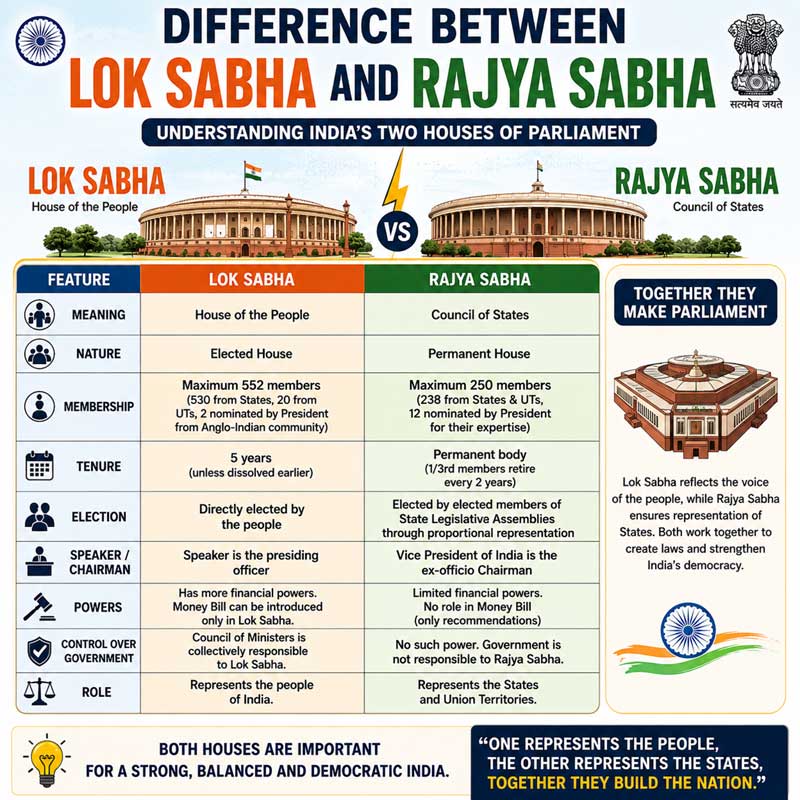
Lok Sabha and Rajya Sabha are the two Houses of the Indian Parliament. While Lok Sabha directly represents the people, Rajya Sabha represents the states and union territories. Both Houses work together to create laws and maintain India’s democratic system.
DOWNLOAD PDF
Difference Between Lok Sabha and Rajya Sabha: Understanding India’s Parliamentary System
India follows a parliamentary form of government based on the principles outlined in the Constitution. The Parliament of India consists of the President and two Houses: the Lok Sabha and the Rajya Sabha.
Although both Houses participate in the law-making process, they differ significantly in their composition, powers, election methods, and functions.
Understanding the difference between Lok Sabha and Rajya Sabha is essential for anyone studying Indian polity, preparing for competitive examinations, or simply wanting to understand how India’s democracy works.
What Is Lok Sabha?
Lok Sabha is known as the House of the People.
Members of the Lok Sabha are directly elected by Indian citizens through general elections. Every eligible voter has the right to elect a representative from their constituency.
The maximum strength of the Lok Sabha is 552 members. At present, the House has 543 elected members.
The term of the Lok Sabha is five years. However, it can be dissolved earlier by the President on the advice of the Council of Ministers.
The Speaker of the Lok Sabha presides over the proceedings and ensures that debates and discussions are conducted according to parliamentary rules.
Since the members are directly elected by the public, the Lok Sabha is considered the most powerful House in matters related to government accountability and financial legislation.
What Is Rajya Sabha?
Rajya Sabha is known as the Council of States.
Unlike the Lok Sabha, members of the Rajya Sabha are not directly elected by citizens. Most members are elected by the elected representatives of state legislative assemblies through a system of proportional representation.
The maximum strength of the Rajya Sabha is 250 members.
Rajya Sabha is a permanent body and cannot be dissolved. Instead, one-third of its members retire every two years, and new members are elected to replace them.
Each member serves a six-year term.
The Vice President of India serves as the ex-officio Chairman of the Rajya Sabha and presides over its proceedings.
The primary role of the Rajya Sabha is to represent the interests of states and union territories in the legislative process.
Major Differences Between Lok Sabha and Rajya Sabha
1. Representation
Lok Sabha represents the people of India.
Rajya Sabha represents the states and union territories.
2. Election Process
Members of the Lok Sabha are directly elected by citizens.
Members of the Rajya Sabha are elected indirectly by elected members of state legislatures.
3. Tenure
The Lok Sabha has a fixed term of five years and may be dissolved before completing its term.
The Rajya Sabha is a permanent body that never dissolves.
4. Membership
The Lok Sabha can have a maximum of 552 members.
The Rajya Sabha can have a maximum of 250 members.
5. Financial Powers
One of the most significant differences between Lok Sabha and Rajya Sabha concerns money bills.
Money bills can only be introduced in the Lok Sabha.
The Rajya Sabha can discuss and recommend changes to money bills, but it cannot reject or amend them.
6. Government Accountability
The Council of Ministers is collectively responsible to the Lok Sabha.
If the government loses a vote of confidence in the Lok Sabha, it must resign.
The Rajya Sabha does not have the authority to remove the government through a no-confidence motion.
Why Does India Need Two Houses of Parliament?
India adopted a bicameral parliamentary system to ensure balanced representation.
The Lok Sabha reflects the voice of the people, while the Rajya Sabha ensures that states have a platform in the legislative process.
This system prevents the concentration of power and allows laws to be examined from different perspectives.
Both Houses play an essential role in protecting democracy, ensuring accountability, and maintaining a balance between the central government and the states.
Without either House, the legislative process would become less representative and less effective.
Key Takeaways
- Lok Sabha is the House of the People.
- Rajya Sabha is the Council of States.
- Lok Sabha members are directly elected by citizens.
- Rajya Sabha members are elected indirectly.
- Lok Sabha can be dissolved, but Rajya Sabha is a permanent body.
- Money bills can only be introduced in the Lok Sabha.
- The government is accountable to the Lok Sabha.