Why Do Mountain Trains Move So Slowly?
SUMMARY
Mountain trains travel at slower speeds because they must navigate steep gradients, sharp curves, tunnels, and changing weather conditions. Railway engineers prioritize passenger safety and track stability, making speed control an essential part of train operations in mountainous regions.
DOWNLOAD PDF
Why Do Mountain Trains Move So Slowly? The Science Behind Railway Travel in Hilly Areas
If you’ve ever traveled on a mountain railway, you may have noticed that trains move much more slowly than those operating on flat terrain. While high-speed trains can exceed 300 kilometers per hour on straight tracks, mountain trains often travel at speeds between 15 and 40 kilometers per hour.
This difference isn’t accidental. It is the result of careful engineering and strict safety requirements.
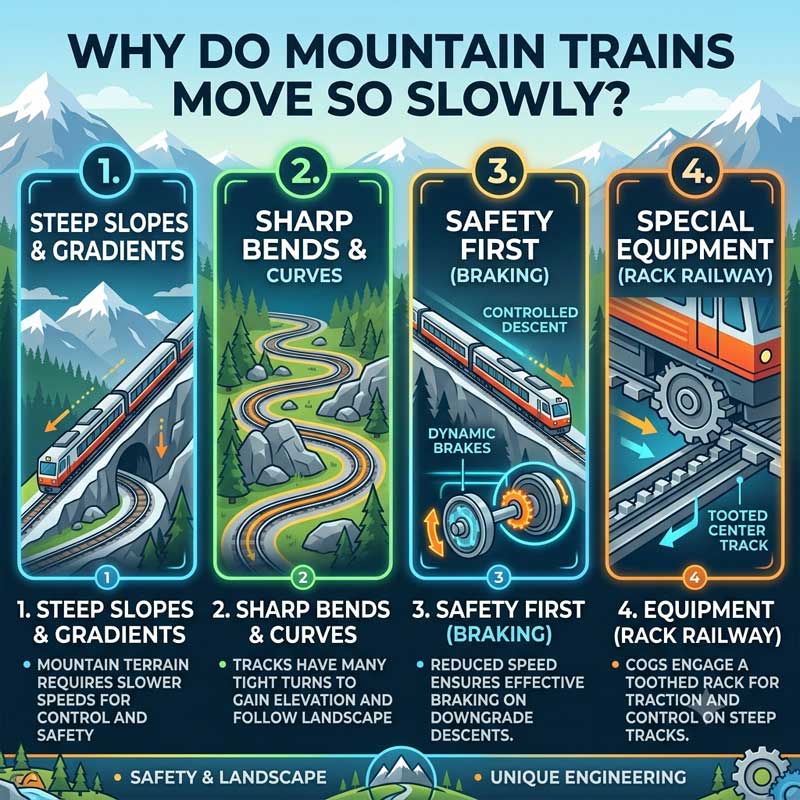
One of the biggest challenges for mountain railways is the steepness of the terrain.
Unlike roads, trains cannot easily climb steep slopes because steel wheels have limited traction on steel rails. Excessive gradients can cause the wheels to slip, especially during wet or snowy conditions.
To overcome this problem, railway engineers design tracks with gradual inclines whenever possible. However, mountains don’t always provide enough space for long, gentle slopes. As a result, trains must reduce their speed while climbing.
Sharp curves present another major obstacle.
Railway tracks in mountainous regions often follow the natural shape of hills and valleys. Instead of moving in straight lines, trains must travel around tight bends.
When a train enters a curve at high speed, centrifugal force pushes it outward. Excessive speed can increase the risk of derailment.
By slowing down, trains maintain stability and allow passengers to travel safely through these turns.
Weather conditions also play a significant role.
Mountain environments are highly unpredictable. Rain, snow, ice, fog, and strong winds can affect visibility and reduce the friction between wheels and rails.
Heavy rainfall can trigger landslides and falling rocks. During winter, snow accumulation can block tracks, while freezing temperatures may create dangerous conditions.
Train operators often reduce speed during adverse weather to minimize risks.
Bridges and tunnels add another layer of complexity.
Mountain railways frequently cross deep valleys using bridges and pass through mountains using tunnels.
Some of these structures are decades or even centuries old. To preserve them and ensure passenger safety, railway authorities often impose speed restrictions.
Track maintenance is another important factor.
Mountain railways experience constant stress from changing temperatures, moisture, and shifting ground.
Regular inspections are necessary to identify damaged rails, loose stones, and weakened infrastructure.
Operating trains at lower speeds reduces wear and tear on the tracks and extends the lifespan of railway systems.
Many mountain railways also have unique engineering designs.
Some use rack-and-pinion systems, which include a toothed rail placed between the standard rails.
Special gears on the train engage with the toothed rail, providing additional traction while climbing steep slopes.
These systems improve safety but naturally limit operating speeds.
Examples of famous mountain railways include the Darjeeling Himalayan Railway in India, the Nilgiri Mountain Railway in southern India, and the Jungfrau Railway in Switzerland.
These railways have become tourist attractions because of their breathtaking scenery and historic significance.
In many cases, the slower speed actually improves the travel experience.
Passengers have more time to enjoy panoramic views of mountains, forests, waterfalls, and valleys. The journey becomes part of the attraction rather than simply a means of transportation.
Modern technology continues to improve mountain railway systems through advanced braking systems, better track designs, and automated safety monitoring.
However, physics still imposes limitations.
Steep slopes, sharp curves, and unpredictable weather make high-speed travel in mountainous regions extremely challenging.
The next time you board a mountain train, remember that its slower speed isn’t a sign of outdated technology. Instead, it’s a carefully calculated decision that balances engineering, safety, and the unique challenges of traveling through some of the world’s most beautiful landscapes.
Key Takeaways
- Mountain trains travel slowly because of steep gradients.
- Sharp curves require lower speeds to prevent derailment.
- Rain, snow, ice, and fog create additional safety challenges.
- Bridges and tunnels often have speed restrictions.
- Track maintenance requirements influence operating speeds.
- Some mountain railways use specialized rack-and-pinion systems.
- Slower speeds improve both passenger safety and sightseeing experiences.
FAQs
1. Why do mountain trains move more slowly than regular trains?
Mountain trains must navigate steep slopes, sharp curves, tunnels, and changing weather conditions, all of which require lower speeds.
2. What is the average speed of a mountain train?
Most mountain trains travel between 15 and 40 kilometers per hour, although speeds vary depending on the route and terrain.
3. Why can’t mountain trains climb steep slopes quickly?
Steel wheels provide limited traction on steel tracks. Climbing steep gradients at high speeds can cause wheels to slip.
4. What is a rack-and-pinion railway?
A rack-and-pinion railway uses a toothed rail and a specialized gear system to help trains safely climb steep mountain slopes.
5. Do weather conditions affect mountain trains?
Yes. Rain, snow, ice, fog, and landslides can significantly affect railway operations and often require trains to reduce their speed.
6. Which are some famous mountain railways?
The Darjeeling Himalayan Railway, Nilgiri Mountain Railway, Kalka-Shimla Railway, and Switzerland’s Jungfrau Railway are among the world’s most famous mountain railways.