Saturn Could Float in Water | Amazing Saturn Facts
Summary
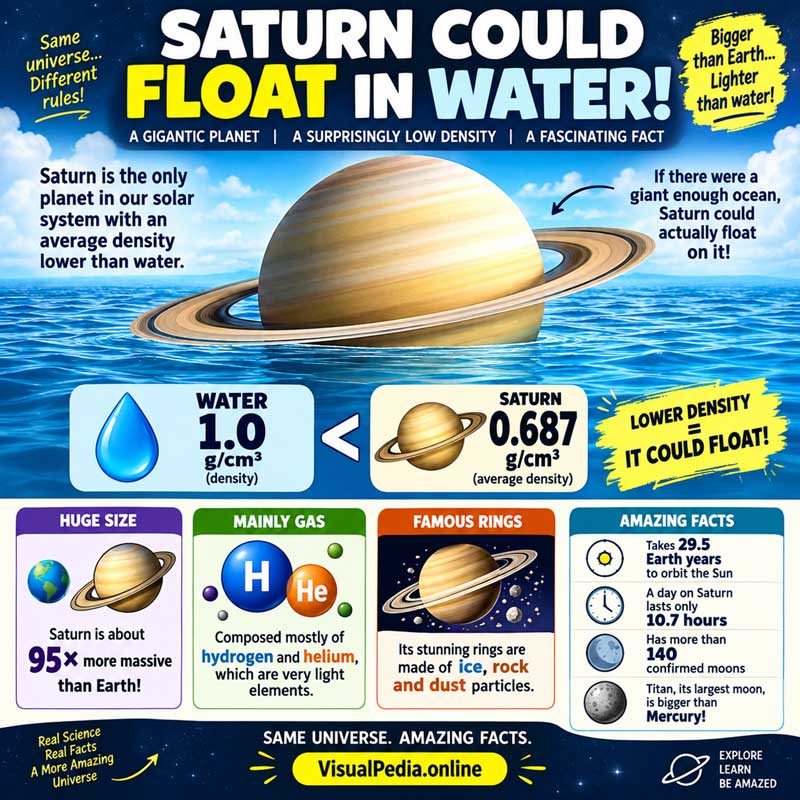
Saturn is the only planet in our solar system with an average density lower than water. Although it could theoretically float in a gigantic ocean, its enormous size and gaseous composition make such a situation impossible in reality.
DOWNLOAD PDF
Why Could Saturn Float in Water?
When people hear that Saturn could float in water, they often think it’s a joke. After all, Saturn is the second-largest planet in our solar system. It has a diameter of approximately 120,500 kilometers and is nearly 95 times more massive than Earth.
Surprisingly, the statement is scientifically correct.
The reason lies in a property called density.
Density measures how much mass is packed into a certain amount of space. Scientists calculate density by dividing an object’s mass by its volume.
Water has a density of 1 gram per cubic centimeter (g/cm³).
Saturn’s average density is only 0.687 g/cm³, which means it is less dense than water.
If there were a large enough body of water, Saturn would theoretically float.
However, there’s an important catch.
No ocean in the universe is large enough to hold a planet the size of Saturn. Therefore, this idea remains a scientific thought experiment rather than something that could actually happen.
Why Is Saturn So Light?
The answer lies in Saturn’s composition.
Unlike Earth, Saturn doesn’t have a solid rocky surface. Instead, it is a gas giant composed mainly of:
- Hydrogen
- Helium
- Small amounts of methane
- Ammonia
- Water vapor
Hydrogen is the lightest element in the universe, while helium is the second lightest. Since these gases make up most of Saturn’s structure, they reduce the planet’s overall density.
Despite being mostly gas, Saturn still contains a dense core made of rock, ice, and heavy elements.
Scientists estimate that Saturn’s core may be several times more massive than Earth. However, the enormous outer layers of hydrogen and helium spread that mass across a huge volume, lowering the planet’s average density.
Would Saturn Really Float Like a Beach Ball?
Not exactly.
People often imagine Saturn sitting on the surface of water like a rubber duck or a beach ball. In reality, the situation would be far more complicated.
The tremendous gravitational forces generated by Saturn would affect the surrounding liquid. Its atmosphere would interact with the water long before the planet could simply rest on the surface.
Furthermore, Saturn’s gravity is about 1.07 times stronger than Earth’s, meaning objects on Saturn would experience gravitational forces similar to those on Earth.
The idea of Saturn floating should therefore be understood as a comparison of densities rather than a real physical event.
Saturn’s Rings Make It Even More Fascinating
Saturn is famous for its spectacular ring system.
These rings consist mostly of:
- Ice particles
- Rock fragments
- Dust
Some particles are as small as grains of sand, while others are several meters across.
Scientists believe the rings may have formed from the remnants of destroyed moons, comets, or asteroids.
Interestingly, the rings contribute very little to Saturn’s overall mass. The planet’s low density is primarily due to its gaseous composition.
Other Interesting Facts About Saturn
- Saturn takes about 29.5 Earth years to complete one orbit around the Sun.
- A single day on Saturn lasts only about 10.7 hours.
- Saturn has more than 140 confirmed moons.
- Its moon Titan is larger than the planet Mercury.
- Powerful storms on Saturn can last for months or even years.
What Can We Learn From This?
The fact that Saturn could float in water teaches us an important scientific lesson.
Size doesn’t always determine whether something sinks or floats.
Density plays the most important role.
A gigantic object can float if its average density is lower than the liquid surrounding it. Saturn is the perfect example of this principle.
Key Takeaways
- Saturn’s average density is only 0.687 g/cm³.
- Water has a density of 1 g/cm³.
- Saturn is the only planet in the solar system less dense than water.
- Saturn is composed primarily of hydrogen and helium.
- Saturn could theoretically float in a giant ocean, but such an ocean doesn’t exist.