How Social science connects daily life with classroom learning
SUMMARY
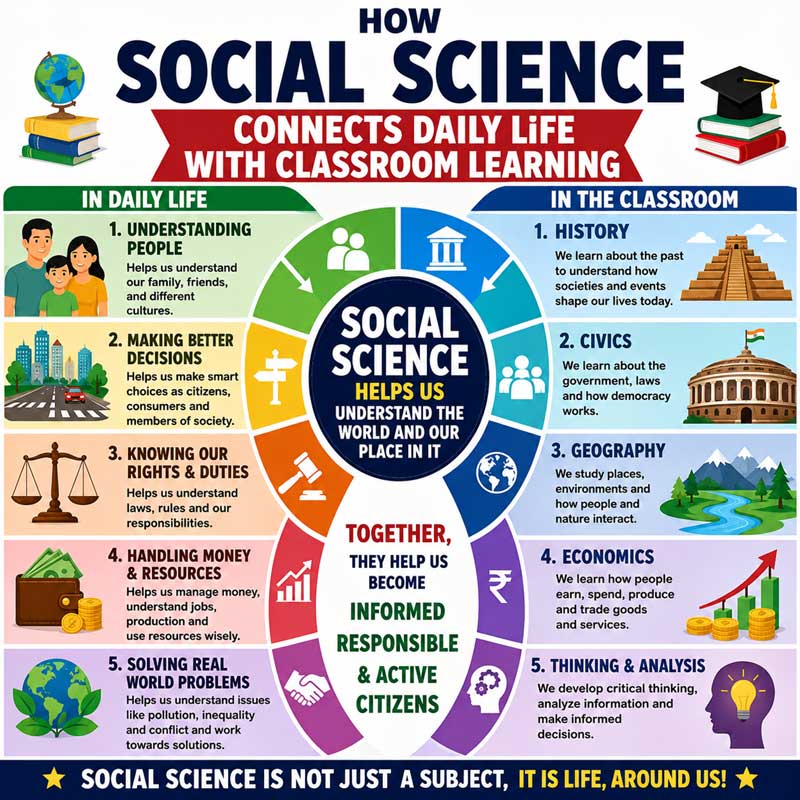
Social science helps students understand the relationship between classroom concepts and real-life experiences. Subjects such as history, geography, economics, and civics explain how societies function, how people interact, and how knowledge gained in school influences everyday decisions.
DOWNLOAD PDF
Social science is much more than a school subject. It is a field of study that helps people understand society, human behavior, culture, government, economics, and the environment. The knowledge students gain in the classroom is directly connected to the world they experience every day.
One of the most important aspects of social science is that it teaches students to understand people and relationships. In the classroom, students learn about communities, cultures, traditions, and social structures. In daily life, they apply this knowledge while interacting with family members, friends, neighbors, and people from different cultural backgrounds.
History, one of the major branches of social science, helps students understand the past. Historical events explain how civilizations developed, how political systems evolved, and how societies changed over time. When students read about historical events in school, they begin to recognize how those events continue to influence modern society.
For example, democratic systems, educational institutions, technological development, and human rights have all been shaped by historical events. By studying history, students learn to appreciate cultural heritage and understand the importance of preserving historical knowledge.
Geography connects classroom learning with the physical world. Students study landforms, climates, natural resources, and human settlements. However, geography extends far beyond maps and textbooks.
Everyday activities such as choosing appropriate clothing based on the weather, understanding seasonal changes, planning travel, conserving water, and recognizing the impact of climate change are all connected to geographical concepts. Geography helps students understand the relationship between humans and their environment.
Economics plays an equally important role in daily life. In school, students learn about production, consumption, trade, markets, and financial systems. Outside the classroom, they use these concepts when purchasing products, creating budgets, saving money, and making financial decisions.
Students who understand basic economic principles develop stronger financial literacy. They become more aware of the value of money, responsible spending habits, and the importance of resource management.
Civics teaches students about governments, laws, rights, duties, and citizenship. These lessons become practical in everyday situations. Understanding traffic rules, participating in elections, respecting laws, protecting public property, and recognizing individual rights are all examples of civics in action.
Through civics education, students learn that being a responsible citizen involves more than simply following rules. It includes participating in community activities, respecting diversity, and contributing to society.
Social science also develops critical thinking and problem-solving skills. Instead of memorizing information, students learn to analyze events, compare different viewpoints, evaluate evidence, and draw conclusions.
These skills are essential in modern society. People regularly encounter news reports, social media content, advertisements, and public debates. Social science provides the tools necessary to distinguish facts from opinions and make informed decisions.
Another important contribution of social science is its ability to create awareness about social issues. Topics such as poverty, inequality, environmental challenges, public health, and globalization become easier to understand when students can connect classroom lessons with real-world examples.
For instance, when students learn about environmental pollution in school, they often become more conscious of waste management and conservation practices at home. Similarly, lessons about social equality may encourage them to promote fairness and inclusivity within their communities.
Social science also encourages empathy. Understanding different cultures, traditions, and historical experiences helps students develop respect for people from diverse backgrounds. This understanding promotes social harmony and strengthens communities.
The connection between social science and daily life demonstrates that education extends beyond examinations and grades. The classroom provides the foundation, while daily experiences reinforce and expand that knowledge.
Ultimately, social science prepares students to become informed, responsible, and active members of society. It teaches them not only how the world functions but also how they can contribute to making it a better place.
Key Takeaways
- Social science connects academic learning with real-life experiences.
- History helps students understand how past events influence modern society.
- Geography explains the relationship between people and the environment.
- Economics teaches financial literacy and resource management.
- Civics promotes responsible citizenship and legal awareness.
- Social science develops critical thinking and decision-making skills.
- Understanding social issues encourages empathy and social responsibility.
- Classroom learning becomes more meaningful when students apply concepts in everyday life.
FAQs
1. What is social science?
Social science is the study of human society, relationships, institutions, cultures, economics, politics, and the environment.
2. Why is social science important in daily life?
Social science helps people understand society, make informed decisions, manage resources, and interact effectively with others.
3. How does history connect to everyday life?
History explains how past events have shaped modern governments, cultures, traditions, and social systems.
4. How does geography influence our daily activities?
Geography affects travel, agriculture, weather patterns, resource management, and environmental conservation.
5. Why is economics considered an important life skill?
Economics teaches people how to manage money, understand markets, save resources, and make better financial decisions.
6. How does civics help students become responsible citizens?
Civics teaches students about laws, rights, responsibilities, and democratic participation, helping them contribute positively to society.
7. How does social science improve critical thinking?
Social science encourages students to analyze information, evaluate evidence, compare perspectives, and make logical decisions.
8. Can social science help solve real-world problems?
Yes. Social science provides insights into issues such as poverty, inequality, climate change, public health, and social development, helping individuals and communities find effective solutions.