Why Do Planets do no Twinkle
SUMMARY
Stars often appear to twinkle in the night sky, while planets usually shine with a steady light. This fascinating difference is caused by Earth’s atmosphere and the way light from distant stars and nearby planets reaches our eyes.
DOWNLOAD PDF
Have you ever looked at the night sky and noticed that some bright objects seem to flicker while others remain steady? This observation has fascinated people for centuries and has become one of the most commonly discussed topics in astronomy.
The simple answer to why do planets do not twinkle lies in the way light travels through Earth’s atmosphere.
To understand this phenomenon, we must first understand what twinkling actually means. Twinkling, also known as stellar scintillation, occurs when light from a celestial object passes through different layers of Earth’s atmosphere before reaching our eyes.
Earth’s atmosphere is not completely stable. It contains layers of air with different temperatures, densities, and movements. These constantly changing layers bend, scatter, and refract light in different directions.
Why Do Stars Twinkle?
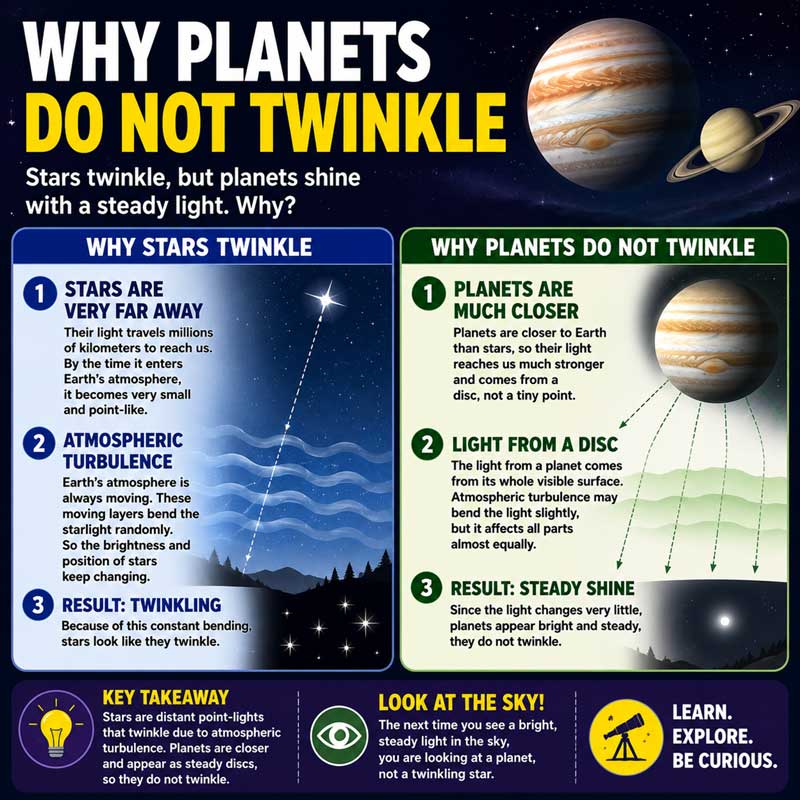
Stars are incredibly far away from Earth. Even the closest stars are located trillions of kilometers from our planet. Because of this enormous distance, stars appear as tiny points of light in the sky.
When light from a star passes through Earth’s turbulent atmosphere, it is repeatedly bent in different directions. Since the star appears as a single point of light, even small changes in the atmosphere can significantly affect how its light reaches us.
As a result, the brightness and position of the star appear to change rapidly, creating the familiar twinkling effect.
This is the scientific explanation behind why do stars twinkle and planets do not.
Why Do Planets Not Twinkle?
Unlike stars, planets are much closer to Earth. Although planets are still millions or even billions of kilometers away, they are close enough to appear as tiny discs rather than point-like objects.
A planet does not send its light from a single point. Instead, light comes from its entire visible surface.
When atmospheric turbulence affects a planet’s light, the distortion occurs across many parts of the planet’s visible disc. Some portions of the light may be bent slightly upward, while other portions may be bent downward.
These changes tend to cancel one another out.
As a result, planets maintain a more stable appearance and do not show the same rapid fluctuations in brightness that stars do.
This explains why do planets do not twinkle even though their light must also travel through Earth’s atmosphere.
The Role of Atmospheric Refraction
Atmospheric refraction is the bending of light as it moves through layers of air with different densities.
Warm air rises while cooler air sinks, creating a constantly changing atmosphere. As starlight passes through these moving layers, the direction of the light changes repeatedly.
Because stars are point sources, these changes become highly visible. In contrast, planets provide multiple light paths that help maintain a steadier image.
Atmospheric refraction is also responsible for other interesting phenomena, such as the apparent movement of stars near the horizon and the shimmering effect observed above hot roads during summer.
Understanding the Concept in School
Students often study this topic in middle and secondary school science courses.
The question why do stars twinkle and planets do not class 8 is frequently included in introductory astronomy chapters. At this level, students learn the basic explanation involving atmospheric refraction and the difference between point sources and extended light sources.
In more advanced science lessons, the topic why do stars twinkle and planets do not class 10 introduces students to concepts such as light refraction, atmospheric density, and the physical properties of celestial objects.
Understanding this phenomenon helps students connect textbook concepts with real-world observations.
Can Planets Ever Appear to Twinkle?
Under certain conditions, planets may appear to twinkle slightly, especially when they are close to the horizon.
Near the horizon, light must travel through a greater thickness of Earth’s atmosphere. This increases atmospheric distortion and can sometimes create a small amount of flickering.
However, this effect is much weaker than the twinkling observed in stars.
Observing the Difference Yourself
You can easily compare stars and planets with the naked eye.
Look for a bright object that shines steadily without noticeable flickering. It is often a planet such as Venus or Jupiter.
Then compare it with nearby stars. You’ll notice that the stars continuously change in brightness, while the planet remains relatively stable.
This simple observation demonstrates one of the most fascinating differences between stars and planets.
The next time you look at the night sky, you’ll know that twinkling isn’t just a beautiful sight. It’s a scientific clue that helps us distinguish distant stars from neighboring planets.
Key Takeaways
- Stars twinkle because their light passes through Earth’s turbulent atmosphere.
- Stars appear as point sources because they are extremely far away.
- Planets are much closer to Earth and appear as small discs.
- Light from different parts of a planet’s surface reduces atmospheric distortion.
- Atmospheric refraction causes the twinkling effect.
- The phenomenon helps astronomers distinguish stars from planets.
- This concept is commonly taught in both Class 8 and Class 10 science.
FAQs
1. Why do planets not twinkle?
Planets do not twinkle because they appear as small discs rather than point sources. Light from different parts of the planet reduces the effects of atmospheric turbulence.
2. Why do stars twinkle?
Stars twinkle because their light passes through constantly changing layers of Earth’s atmosphere, causing variations in brightness and position.
3. Why do stars twinkle and planets do not?
Stars are much farther away and appear as point sources, making atmospheric disturbances more noticeable. Planets appear as discs, which helps maintain a steady light.
4. Is this topic included in Class 8 science?
Yes. The concept is commonly taught in astronomy chapters and is often discussed as why do stars twinkle and planets do not class 8.
5. Is this topic included in Class 10 science?
Yes. Many science curricula discuss this phenomenon under light and atmospheric refraction concepts, often referring to why do stars twinkle and planets do not class 10.
6. Can planets twinkle at all?
Yes, but only slightly under certain atmospheric conditions, especially when they are close to the horizon.
7. Which planets are easiest to identify in the night sky?
Venus, Jupiter, Mars, and Saturn are usually the easiest planets to identify because they are bright and often appear as steady points of light.